Chatham-Savannah Citizen Advocacy

Keeping the social in social change

The Citizen Blog...

Category archives for About Citizen Advocacy »

People say the darndest things…

Two quick quotes – one next to the other in this Sunday’s New York Times to remind us of just how differently people see what is “right.”


“I was making a crazy amount of money and not even pitching. Honestly, I didn’t feel like I deserved it.” from Gil Meche, an injured pitcher for the Kansas City Royals who gave up his 12 million dollar guaranteed contract for 2011 and retired. Is this man a hero, simply honest, or a chump?


“The greatest tragedy would be to accept the refrain that no one could have seen this coming and thus nothing could have been done.” from a report by a Federal panel concluding that the financial crisis was an avoidable disaster caused by widespread failures in government regulation, corporate management and heedless risk taking by Wall Street. The words regulation, management and taking could be regulators, managers and takers. It was people – not papers – that acted. Some of the “smartest” men and women in the world were seemingly not able to see what was RIGHT – no pun intended – in front on them, created by their own actions and inactions…


Sometimes “everybody” is really nobody. Sometimes one person’s actions can ignite the moral imagination of a nation, a town, an organization or simply one other person.

Looking forward to the new year…

As we end the year I thought I might offer some thoughts about the purpose we share under the banner of Chatham-Savannah Citizen Advocacy.


Our shared purpose is to provide protection to and advocacy for/with people who are marginalized because of prejudice toward disability.


We bring people who would not ordinarily meet into meaningful relationship with one another. We have done this for more than 30 years using a model called Citizen Advocacy.


We do this so that people who live isolated lives, lives that are only witnessed by paid staff persons, or sometimes by no person, will have someone who is voluntarily and intentionally in their corner.


We do this so that people who live big busy lives can be in solidarity with someone whose life looks different on the outside, with the hope that they will discover that they share many of the same hopes, dreams and needs on the inside, inside their souls. We call this identification, when the advocate identifies with the life, the soul of the other person.


We do this as a way to encourage both people to be the most they can be as human beings.


This is an idea that can have great strength and fragility. It is an idea that becomes real as people find ways to be together, working on practical matters as well as finding ways to share pleasure and enjoyment.


As an organization we have to try and be curious about ourselves. It is easy to fall into unconscious busyness, missing the chance to refresh, re-frame and re-establish our passion.


As we start the New Year, let’s all work together to ask the important questions, create useful ideas, celebrate good news and make meaning out of all that comes our way.


Looking forward to a New Year !!!!

What’s it like to be a citizen advocate? What’s it like to have a citizen advocate?

Tom Kohler asked several long time citizen advocates and several protege’s matched with citizen advocates in Savannah to share their insights with some folks newly involved…


What does it feel like to be an advocate? What would you want prospective advocates, or people very newly involved to hear?


“You really don’t know very much about what you are supposed to be doing. The stakes can be high, the issues you are negotiating and speaking to are new to you. I was simply scared of not doing the right thing.”


“I was not trusted. The man I met had been let down so many times, in so many ways and for almost his whole life. I felt fearful of failing by letting him down again. I also was looking too far down the road at first, trying to figure out more than I could, or even should. I had three basic feelings: fear. confusion and confidence. Confidence that I knew enough people, knew how to do things and that the man I’d met and I had enough in common that something reasonable would work out.”


“In the beginning, I felt resented by my protégé’s family. Life and lifestyle for everyone had become predictable. Now I’m listening to my protégé who has a new dream, and both the dream and me are now being resented by his family.”


“At first my intellect was in charge. Then my emotions took over and I knew there was no going back. I also began to go step by step on the issues my protégé faced, which helped me feel less overwhelmed. I also began to realize and acknowledge the positive changes in my own life that were coming from this. The idea of receiving and giving became so real.”


“I remember getting scared. I became more serious when I learned about the realities of how strong some people’s biases and prejudices were and of how so many of my protégé’s life experiences matched the discussions about the wounds of devalued people I was having with the staff.”


“At first I focused on an issue, a task. As we waited for that to be resolved, we began to feel the relationship part grow. Seeing a movie together, the sharing of meals also became important.”


“My protégé and I really began to share emotions. His hurts really began to become my hurts, his victories mine. He began to experience my life in the same way. How I was doing was important to him.”


“Overtime, I’d say that I’ve gone from thinking the tasks at hand are the most important and now feel like it’s the person and the relationship that matter the most. It helps to listen to what the person is saying, often taking their direction and breaking it down into action steps.”


What does it feel like to have a citizen advocate?


“I was wondering how we could connect. Here’s this business man from a different world than I live in. I was wondering, ‘What is right to expect, to hope for? Am I asking too much? Where’s the limit? I don’t want to cross the line.’ I’ve had what I call traditional relationships that come through family and church. I’ve been struck by the clear feeling that my advocate is on my side, rather than someone who is always assessing my position and second-guessing my point of view. The intentionality, the clarity of the advocate’s willingness, makes it easier to ask for help. I hate asking for help.”


“Being asked to tell my whole life story to the coordinator was great. Piecing it together, editing it, and getting it right so that the prospective advocate would hear it clearly helped me feel more confident.”


“It’s commonalities, not disability, that this is built around. Everyone else is interested in my disabilities – not my life, not me. There was lots of communication back and forth before the first meeting and that helped me feel like I knew something about the advocate and he knew something about me before we met. At the first meeting I felt sincerity.”

Some Frequently Asked Questions about citizen advocacy…

What do you do? We make matches between a person who is well-connected in our community and a person who has a disability who is not well-connected and is facing a tough road ahead. We make about 20 – 25 new citizen matches a year and support about 125 ongoing citizen advocacy relationships, some of which have been matched for the long term – 5, 10, 20 and some 30 years now.


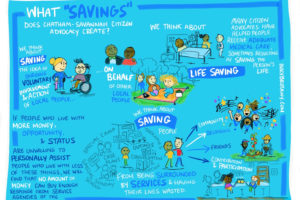
What do advocates do? There are many roles a citizen advocate might play. It depends on the situation that the person with whom they are matched is in. A citizen advocate who is matched with a young person in an institution might need to monitor services, protect the person from harm, speak out against abuse and neglect and likely push for a better living situation. A citizen advocate who is matched with a child in special education classes in our public school system might need to negotiate with school personnel and speak out for better educational opportunities. A citizen advocate who acts as a representative payee might help a person budget, monitor their finances and help set up a savings plan. A citizen advocate who is matched with a person who is in the hospital may have to speak and act to save the person’s life and advocate for the best treatment.


Why have I not heard of you before? We do not advertise because the work we do is personal and it is done one-to-one. We learn a lot about people’s lives and their histories and their stories. We want to respect the stories of people’s lives. They may choose to let us share their stories. Recruiting citizen advocates is best done through “trust networks” of people who are introduced to the work by people they know and trust. Board members, citizen advocates and friends of the office introduce us to fine people that they know and trust and invite those people to learn more about the organization and perhaps to become involved as citizen advocates in the future.


How do you make matches? We start by getting to know the person with the disability. We write a short story that offers some history and some of the issues that the person is facing. We think about a role a citizen advocate might play in this person’s life. We think about the qualities that the citizen advocate should have. Then we go to our trust networks and ask, “Who do you know that…” We then talk with the potential advocate, learn as much as we can about them and then if what we have learned points to a good match, we introduce the two people. We meet together several times and then both people decide if they would like to be matched in a citizen advocacy relationship. We help with first steps and then we support the match as needed.


Do all matches work? No. Citizen advocacy matches are as weak and as strong as any human relationship. Sometimes they are more than we could ever imagine. Sometimes people have good intentions, but no follow through. Sometimes the office does not offer good support to a match in trouble. Sometimes they fizzle before the two people have an opportunity to get connected.


How long have you been in existence? Since 1978.


Are you a 501 c 3? Yes. We will get you a copy of our exemption letter if needed.


What financial controls are in place? Our Treasurer, Mike English, reviews finances monthly and signs all checks. Skinner, Barndollar and Lane C.P.A. reviews our books quarterly. David Pelliccione C.P.A. audits our books yearly.


Why don’t you get more government money, United Way money, regional and national grants etc? Our financial strategy is to increase our local grassroots contributions and decrease our dependence on government money. We also avoid grants with cumbersome application and reporting procedures and grants that may divert us from our mission – making and supporting citizen advocacy matches in Savannah. We feel that the security of the organization is in the hands of our local, grassroots giving community. We avoid any money that comes from agencies or organizations that provide services or funds to human service agencies (like United Way). It is likely that a citizen advocate will be speaking out against one of these agencies as they try to make their protégé’s life better. We prefer not to take money from donors that might put us in a real or perceived conflict of interest.


Why does citizen advocacy matter? Because people are important. Citizen advocacy is an opportunity to put values into action on behalf of one person. Because of citizen advocacy, hundreds of people in our community have gotten this opportunity to put their values into action and try to make one person’s life better in big and small ways. We hope that because of citizen advocacy, our community is a kinder, gentler and more just place to live.

Authors and students kickoff AASU’s Common Read

Approximately 500 students joined Waddie Welcome and the Beloved Community’s authors Tom Kohler and Susan Earl publishers from Inclusion Press at the Common Read Kickoff on September 1st at Armstrong Atlantic State University.


Publishers Jack Pearpoint and Lynda Kahn put together this brief video – enjoy and check out the other videos from this event on Inclusion Press’ YouTube channel as well.


Common Read Kickoff at Armstrong Atlantic